There is no single “better” setting for ABA therapy — the right choice depends on your child’s age, needs, and goals. In-home ABA therapy delivers sessions in your child’s natural environment (home, and often daycare or community settings), focusing on real-life routines and family involvement. Center-based ABA therapy takes place in a dedicated clinic with structured spaces, peer interaction, and access to multiple therapists at once. Research supports both models; the right fit comes down to what your child needs to learn and where they’ll need to use those skills.
This guide breaks down exactly how each model works, what the research actually shows (including where studies disagree), a full side-by-side comparison, and the specific questions to ask any provider before you commit.
What Is In-Home ABA Therapy?
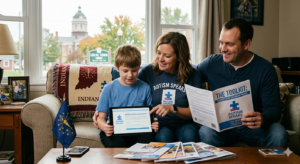
In-home ABA therapy delivers Applied Behavior Analysis directly in a child’s natural environment — most often their home, but also daycare, school, or community settings. A Registered Behavior Technician (RBT), supervised by a Board Certified Behavior Analyst (BCBA), teaches and reinforces skills using the child’s own toys, routines, and family members.
This model is often called Natural Environment Teaching (NET) because it embeds learning into everyday moments — mealtime, playtime, getting dressed — rather than isolating skills in a clinical setting. Because parents and siblings are present and coached in real time, skills are practiced in the exact context where the child will actually need to use them.
What Is Center-Based ABA Therapy?
Center-based ABA therapy takes place in a dedicated clinic built specifically for therapy: structured workstations, sensory rooms, and small-group spaces designed to minimize distraction. Multiple BCBAs and RBTs typically work on-site, allowing for real-time collaboration, more built-in peer interaction, and often longer daily session blocks.
This model tends to rely more heavily on structured teaching methods like Discrete Trial Training (DTT), where skills are broken into small, repeatable steps practiced in a controlled setting before being generalized elsewhere.

In-Home vs. Center-Based: Full Comparison Table
| Factor | In-Home ABA Therapy | Center-Based ABA Therapy |
|---|---|---|
| Setting | Child’s natural environment (home, daycare, community) | Dedicated clinic |
| Teaching style | Naturalistic teaching embedded in daily routines | Structured, often more Discrete Trial Training |
| Family involvement | High — parents coached in real time during sessions | Moderate — typically via scheduled parent training sessions |
| Peer interaction | Limited unless siblings/playdates are involved | Built in — peer play and social groups are part of the model |
| Skill generalization | Skills are learned directly in the context they’ll be used | Skills are learned in the clinic, then generalized to home/community afterward |
| Distractions | More variable — home has its own routines and interruptions | Minimized by design |
| Access to multiple clinicians | Typically one RBT per session, with BCBA supervision | Multiple BCBAs/RBTs often on-site simultaneously |
| Session intensity | Flexible, often fits around family schedule | Often longer, more intensive daily blocks |
| Best fit | Younger children, home-specific behaviors, families wanting hands-on coaching | Children needing high-intensity early intervention or significant peer/social skill building |
What Does the Research Actually Say?
Here’s the honest picture: the research does not universally favor one model, and any article claiming otherwise is oversimplifying.
- Some studies point to center-based settings producing faster skill acquisition per therapy hour, largely attributed to reduced distractions and more consistent BCBA oversight.
- Other research finds that in-home ABA produces strong, statistically significant gains in communication and social skills, with the added advantage of skills being learned directly in the environment where the child needs to use them — removing the extra step of generalizing a skill from clinic to home.
- What most researchers agree on: treatment intensity, consistency, and quality of BCBA supervision matter more than the setting itself. A well-supervised, appropriately intensive program in either setting outperforms a poorly supervised program in the “better” setting.
- Family involvement is consistently linked to stronger long-term outcomes in both models — but in-home ABA structurally builds this in, since parents are present and coached during nearly every session.
In short: center-based therapy may have an edge in raw acquisition speed for some skills, while in-home therapy has a structural advantage in generalization and parent capability-building. Neither finding cancels out the other.
Who Is In-Home ABA Best For?
In-home ABA tends to be the strongest fit when:
- Your child is very young (under 5) and still building foundational routines at home
- Specific challenging behaviors mainly occur at home (mealtime refusal, bedtime routines, sibling conflict)
- You want to be directly coached as a parent, not just given a report after the fact
- Your child has significant separation anxiety or struggles to transition to new environments
- Transportation, scheduling, or a packed household routine makes daily clinic visits impractical
Who Is Center-Based ABA Best For?
Center-based ABA tends to be the strongest fit when:
- Your child needs high-intensity early intervention (multiple hours per day, several days per week)
- Social and peer-interaction goals are a primary focus
- Your child benefits from a highly structured, low-distraction environment to build foundational skills before generalizing them
- You want built-in access to multiple clinicians collaborating on your child’s plan in real time
Can You Combine Both Models?
Yes — and for many families, a blended approach captures the strengths of both. A common model: foundational skills are introduced in a more structured setting or session, then deliberately practiced and reinforced in the home and community through natural environment teaching. The key is a treatment team that actively coordinates between settings rather than treating them as separate, disconnected programs.
Common Mistakes Parents Make When Choosing
Mistake 1: Assuming one setting is objectively “better” for every child.
The right setting depends on your specific child’s needs, age, and goals — not a universal ranking.
Mistake 2: Choosing based on convenience alone.
Convenience matters, but it shouldn’t override whether the setting actually matches your child’s behavioral and skill-building priorities.
Mistake 3: Not asking about BCBA supervision hours.
The setting matters less than how closely a BCBA is actually supervising the RBT delivering your child’s sessions — ask this directly of any provider.
Mistake 4: Assuming in-home means “less structured” or “less effective.”
High-quality in-home ABA follows the same individualized, data-driven treatment plan as center-based ABA — the environment changes, not the clinical rigor.
Mistake 5: Not revisiting the decision over time.
The right setting can change as your child grows. A child who started in-home at age 2 may benefit from more center-based peer work at age 4, or vice versa.
Questions to Ask Any ABA Provider
- How many hours per week will a BCBA directly supervise my child’s sessions, regardless of setting?
- How do you measure and report progress toward specific goals?
- How do you handle skill generalization if therapy happens primarily in one setting?
- What does a typical session actually look like, hour by hour?
- How are parents trained and coached to reinforce skills outside of sessions?
- What is your process if my child’s needs change and a different setting becomes more appropriate?
- How quickly can services start after my child’s diagnosis?

What to Expect From In-Home ABA at Little Hearts ABA
Little Hearts ABA delivers therapy through a Natural Environment ABA Therapy model — sessions take place in your child’s own home and daily routines, led by a trained RBT under ongoing BCBA supervision. Parents are actively coached during sessions, not just briefed afterward, and treatment plans are built around the specific behaviors and goals that matter most in your family’s day-to-day life.
For families whose child would also benefit from structured peer interaction, Little Hearts ABA’s Social Skills Groups run as a complementary, separate service — allowing families to combine the generalization strengths of in-home ABA with dedicated social skill-building in a group setting.

Signs It Might Be Time to Reconsider Your Child’s Setting
The right setting isn’t a one-time decision. Watch for these signals that it may be worth revisiting with your BCBA:
- Progress has plateaued for several review cycles despite consistent attendance and effort — this is worth a direct conversation about whether the environment itself is a limiting factor.
- Your child has mastered foundational skills at home but struggles to use them anywhere else, which may point toward adding structured peer or community practice.
- New goals have emerged — for example, a child approaching preschool age may benefit from more group-based social practice than was needed at 18 months.
- Household changes have made in-home sessions harder to run effectively, such as a new sibling, a move, or a shift in daily schedule.
- Your child is showing strong interest in other children and would benefit from dedicated peer practice beyond what’s available at home.
None of these signs mean the current setting has failed — they simply mean it’s worth a conversation about whether your child’s goals have evolved.
How Does Setting Affect Cost and Insurance?
Cost structures for in-home and center-based ABA therapy are generally similar when insurance covers the service as medically necessary, since coverage typically follows the diagnosis and treatment plan rather than the delivery setting. That said, a few practical factors can affect your out-of-pocket experience:
- Travel and time costs tend to be lower with in-home therapy, since you avoid daily transportation to and from a clinic.
- Missed-session policies can vary — ask any provider how illness, scheduling conflicts, or family travel are handled in each setting.
- Session length and frequency sometimes differ by setting (center-based programs often run longer daily blocks), which can affect your total weekly time commitment even if the hourly coverage rate is the same.
The most reliable way to understand your actual cost is to have your specific plan verified directly by the provider before you commit to a setting — ask this as a concrete first step rather than estimating from general online figures.
Expert Recommendations
- Prioritize BCBA supervision quality over setting. Ask specifically how many hours per week a BCBA reviews and adjusts your child’s program.
- Match the setting to the goal, not the other way around. If the priority behavior only shows up at home, therapy delivered elsewhere will always need an extra generalization step.
- Involve yourself as a parent regardless of setting. Programs that actively coach parents produce more durable, longer-lasting skill gains than programs where parents are passive observers.
- Reassess as your child grows. The right setting at age 2 is not necessarily the right setting at age 5 — build in a regular review of whether the current model still fits.
Statistics Every Parent Should Know
- Early intensive behavioral intervention is one of the most researched treatments for autism spectrum disorder, with decades of published outcome data across both home and clinic settings.
- Higher treatment intensity and earlier start age are consistently linked to stronger outcomes across the ABA research base, regardless of setting.
- Family involvement is one of the most consistently cited predictors of durable, long-term skill generalization in ABA outcome research.
- An estimated 30–40% of autistic children also meet criteria for ADHD, which can affect how therapy intensity and structure are tailored regardless of setting.
Sources: peer-reviewed ABA outcome literature; National Institute of Mental Health.
Frequently Asked Questions
Is in-home ABA therapy as effective as center-based ABA therapy?
Both models are evidence-based and can be highly effective. Some research suggests center-based settings support slightly faster raw skill acquisition, while in-home therapy has a structural advantage in generalizing skills to real-life routines. The quality of BCBA supervision and treatment intensity matter more than the setting itself.
How many hours of in-home ABA therapy does my child need?
Recommended hours vary widely by child, based on the severity of needs and specific goals identified during the diagnostic evaluation. A BCBA determines an individualized recommendation, which is regularly reviewed and adjusted as your child progresses.
Can in-home ABA therapy address behaviors that happen at daycare or school?
Yes, in many cases. In-home ABA providers can often extend sessions into daycare, preschool, or community settings when those environments are relevant to a child’s goals, in coordination with the family and, where appropriate, the school.
Does insurance cover in-home ABA therapy the same way it covers center-based therapy?
In most cases, yes — insurance coverage for medically necessary ABA therapy typically applies regardless of setting, though specific plan details vary. A provider that verifies your benefits directly can confirm your coverage for either model.
Will my child eventually need center-based therapy even if they start in-home?
Not necessarily. Many children remain in an in-home model throughout their ABA therapy journey. Some families transition to a blended or center-based approach later if social/peer goals become a bigger priority — but this is an individual decision, not a required progression.
How involved do parents need to be during in-home ABA sessions?
Active parent involvement is a core part of the in-home model. Parents are typically coached directly during sessions so they can reinforce skills between visits, which is one of the model’s key advantages.
What happens during a typical in-home ABA session?
A session typically includes a mix of structured skill-building activities and naturalistic teaching embedded in play or daily routines, with the RBT collecting data throughout to track progress toward specific goals.
Is center-based ABA therapy better for social skills specifically?
Center-based settings do have a structural advantage for social skill-building simply because peer interaction is built into the environment. Families focused heavily on peer/social goals sometimes pair in-home ABA with a separate social skills group to get both benefits.
Can we switch from in-home to center-based ABA therapy later if needed?
Yes. The right setting can change as a child’s needs evolve, and most providers can help transition or blend models as goals shift over time.
What questions should I ask before choosing an ABA provider?
Ask about BCBA supervision hours, how progress is measured and reported, how skills are generalized across settings, what a typical session looks like, and how quickly services can start after diagnosis.
Conclusion
There’s no universal answer to “in-home or center-based” — the right choice depends on your child’s age, specific goals, and what actually needs to change in their day-to-day life. What matters most, across either setting, is treatment intensity, consistent BCBA supervision, and genuine family involvement.
If your child has recently been diagnosed and you’re ready to start therapy, the best next step is a conversation with a BCBA who can walk through your child’s specific goals and recommend the right fit — not a generic answer from an article. Little Hearts ABA delivers Natural Environment ABA Therapy directly in your home, with real-time parent coaching and a plan built around your family’s actual routines. Contact our team today to talk through what therapy could look like for your child.